

Table of Contents
- Why a Stress-Free Wedding Day Itinerary Starts With a Single Source of Truth
- What You'll Need Before You Build Your Wedding Day Schedule
- Step 1: Calculate Realistic Durations and Buffer Time for Every Activity
- Step 2: Build Your Wedding Photography Timeline Around the Ceremony
- Step 3: Map Reception Events, Meal Service, and Transitions
- Wedding Timeline Examples for Different Formats and Guest Counts
- Use a Wedding Day Itinerary Template That Updates in Real Time
- Common Mistakes That Derail a Wedding Day Itinerary (and How to Avoid Them)
- Frequently Asked Questions
Last Updated: October 9, 2026
Why a Stress-Free Wedding Day Itinerary Starts With a Single Source of Truth
Creating a stress free wedding day itinerary comes down to one decision: pick one document everyone trusts.
At Ever After Suite, we build planning tools around that single-source idea.
Change a start time and you text the photographer, call the venue, forget the DJ.
What You'll Need Before You Build Your Wedding Day Schedule
Before you write a single time slot, gather the facts that lock your day in place. Skipping this step is why timelines fall apart.
Gather Your Venue Times, Vendor Arrival Windows, and Guest Count
Call your venue first for your access window, setup rules, and curfew, then confirm vendor arrival times in writing.
- Venue access start and end times
- Ceremony and reception curfew
- Vendor arrival windows (photographer, DJ, florist, caterer)
Put all of this in one file. A spreadsheet works, but a connected planner keeps vendor contacts, guest list, and timeline together.
Set Your Non-Negotiables: Ceremony Time and Venue Curfew
Your ceremony time is the anchor; everything else counts backward or forward from it. Two fixed points matter most:
- Ceremony start time. This rarely moves. Vendors and guests plan around it.
- Venue curfew. Your hard stop for music, noise, and guest departure.
Write both at the top of your schedule. Every other event fits between them.
Step 1: Calculate Realistic Durations and Buffer Time for Every Activity
Most timelines fail because they use wishful durations. Time each activity, then add a buffer.
Use this formula:
Real duration = your best estimate + 25% buffer
If hair and makeup takes two hours, plan for two and a half. If travel takes 20 minutes, plan 30.
Here is a simple way to set buffers by activity type:
| Activity Type | Add This Buffer | Why |
|---|---|---|
| Getting ready | 20-30 min | Late arrivals, outfit fixes |
| Travel | 10-15 min | Traffic, parking, loading |
| Photos | 10-15 min | Group gathering takes time |
| Meals | 15 min | Service runs long |
| Transitions | 10 min | Guests move slowly |
Getting Ready, Hair and Makeup, and the Morning Window
The morning window is where timelines quietly break: hair and makeup always run long for someone.
A common approach is to stagger start times:
- First person starts 30 minutes before the next
- Build in one open slot for touch-ups
- Keep the person getting married near the end, not the start
Travel Time Between Venues and Transition Time Between Events
Travel time is not just drive time. It includes loading, parking, and walking.
Add these to every trip:
- 5 minutes to gather and load
- Drive time plus 10 minutes for traffic
- 5 minutes to park and walk in
If you have two venues, do a test drive at the same time of day as your wedding. Traffic changes everything.
Step 2: Build Your Wedding Photography Timeline Around the Ceremony
Build your wedding photography timeline around the ceremony, not the photographer's convenience. Photos take longer than couples expect, especially with large families.
Start with these fixed photo blocks:
- First look (if you want one)
- Wedding party portraits
- Family portraits
First Look, Wedding Party Portraits, and Family Photo Session
A first look gives you a private moment and lets you finish most photos before the ceremony.
Plan realistic blocks:
- First look: 15-20 minutes
- Wedding party portraits: 20-30 minutes
- Family portraits: 30-45 minutes
For family photos, give your photographer a written list grouped by side and size. This alone saves 10 minutes.
Cocktail Hour Photos and Couple Portraits Before Reception
Cocktail hour is your best photo window. Guests are busy, and you are free.
Use it for:
- Couple portraits
- Extended family shots
- Venue and detail photos
Then join your guests for the last 15 minutes. You paid for the cocktail hour. Enjoy some of it.
Step 3: Map Reception Events, Meal Service, and Transitions
Reception events need a set order that matches how people actually eat and celebrate. Meal service is the backbone.
A simple sequence:
- Grand entrance
- First dance (or after dinner)
- Welcome and blessing
- Meal service begins
- Speeches during or after the meal
- Parent dances
- Open dancing
- Cake cutting
- Bouquet and garter toss (optional)
- Last dance and send-off
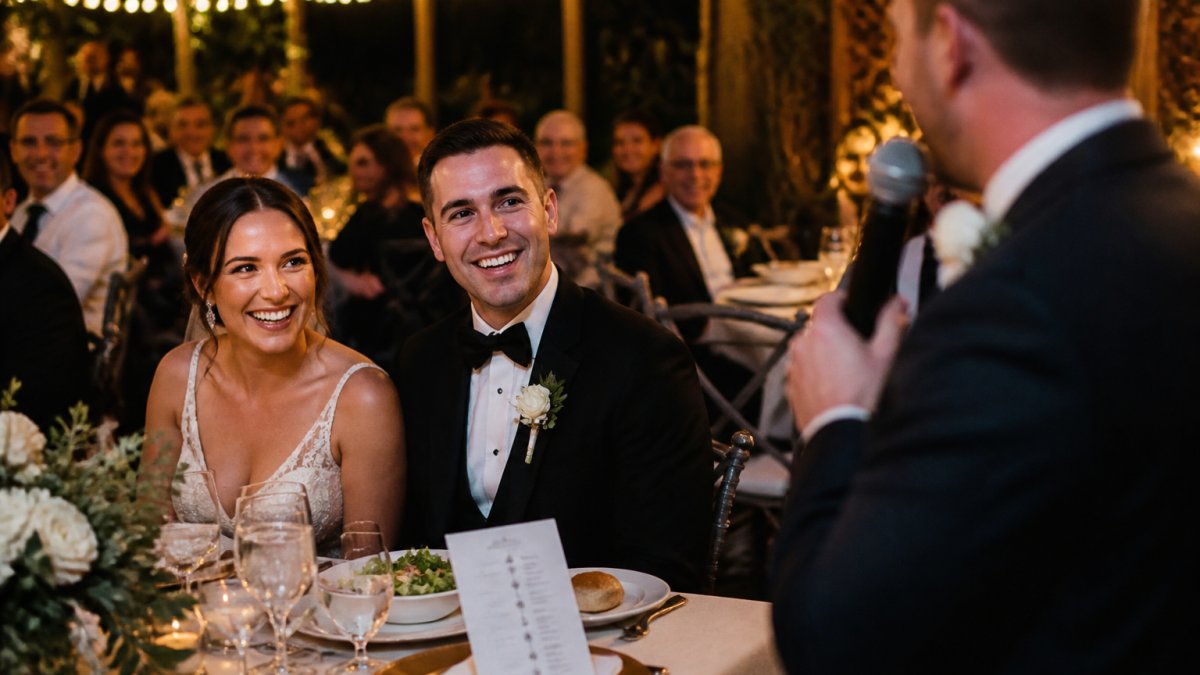
Speeches, First Dance, and When to Cut the Cake
Timing these three well keeps the night moving.
- Speeches: Place them after guests are seated with food, or right after the meal. Two to four speeches, three minutes each.
- First dance: Before dinner works if you want guests seated and watching. After dinner works if you want the floor packed.
- Cake cutting: Cut it after the first round of dancing, then serve dessert. This gives the kitchen time and keeps guests on their feet.
Wedding Timeline Examples for Different Formats and Guest Counts
Different weddings need different shapes: a 50-person backyard brunch moves nothing like a 200-person ballroom evening. Below are four sample itineraries you can adapt, plus the rules that make each work.
Printable Wedding Day-Of Binder — Vendor Contacts, Timeline, Seating Chart →
Sample Itinerary: Classic Evening Wedding (100 Guests, One Venue)
| Time | Event |
|---|---|
| 1:00 p.m. | Getting ready begins; hair and makeup stagger starts |
| 3:30 p.m. | First look and couple portraits |
| 4:00 p.m. | Wedding party portraits |
| 4:30 p.m. | Family portraits |
| 5:00 p.m. | Guests arrive; pre-ceremony music |
| 5:30 p.m. | Ceremony (30 min) |
| 6:00 p.m. | Cocktail hour; couple finishes portraits |
| 7:00 p.m. | Grand entrance and welcome |
| 7:15 p.m. | Meal service begins |
| 8:00 p.m. | Speeches (3 x 3 min) |
| 8:20 p.m. | First dance and parent dances |
| 8:35 p.m. | Open dancing |
| 9:30 p.m. | Cake cutting and dessert |
| 10:00 p.m. | Bouquet and garter toss (optional) |
| 10:45 p.m. | Last dance |
| 11:00 p.m. | Send-off; venue curfew |
Sample Itinerary: Morning Brunch Wedding (60 Guests)
Brunch weddings run on a tighter clock: guests arrive and leave earlier, and the meal is the anchor, not the dance floor.
| Time | Event |
|---|---|
| 6:30 a.m. | Getting ready begins |
| 8:30 a.m. | First look and couple portraits |
| 9:00 a.m. | Family portraits |
| 9:30 a.m. | Guests arrive; coffee and pastries |
| 10:00 a.m. | Ceremony (20-25 min) |
| 10:30 a.m. | Group photos; guests move to brunch |
| 11:00 a.m. | Brunch service and mimosas |
| 11:30 a.m. | Toasts |
| 11:50 a.m. | First dance (optional) |
| 12:15 p.m. | Cake cutting |
| 12:45 p.m. | Farewell; guests depart by 1:00 p.m. |
Sample Itinerary: Multi-Venue Wedding (Ceremony and Reception Apart)
The risk here is the gap between venues. Build a real transition block, not a wishful one.
| Time | Event |
|---|---|
| 2:00 p.m. | Getting ready begins |
| 4:00 p.m. | First look at ceremony venue |
| 4:45 p.m. | Guests arrive at ceremony venue |
| 5:00 p.m. | Ceremony (30 min) |
| 5:30 p.m. | Cocktail hour at ceremony venue |
| 6:15 p.m. | Guests board shuttle; 20-min drive + 10-min buffer |
| 6:45 p.m. | Guests arrive at reception venue |
| 7:00 p.m. | Grand entrance and welcome |
| 7:15 p.m. | Dinner service |
| 8:15 p.m. | Speeches |
| 8:35 p.m. | First dance and open dancing |
| 10:30 p.m. | Last dance |
| 10:45 p.m. | Shuttle returns guests to parking |
Sample Itinerary: Culturally Specific or Multi-Ceremony Wedding
Many traditions include multiple ceremonies, outfit changes, or guest greetings. Treat each as its own block with its own buffer.
A common pattern for a two-ceremony day:
- Ceremony one (traditional or religious): 45-60 minutes, plus 20 minutes for processional and recessional photos
- Outfit change and reset: 45-60 minutes, including hair touch-ups and a quiet room
- Ceremony two (civil or second tradition): 30-45 minutes
If your day includes a tea ceremony, a hora, a money dance, or a multi-day celebration, ask the person leading that tradition how long it actually runs.
How to Adapt Any Sample to Your Guest Count
Guest count changes duration more than most couples expect:
- Under 50 guests: Cut cocktail hour to 45 minutes and shorten the receiving line. Photos move faster because there are fewer groups.
- 50-150 guests: The samples above are built for this range.
- 150+ guests: Add 15 minutes to meal service, 10 minutes to the receiving line, and 15 minutes to the send-off. Seating 200 people takes real time.
For a full wedding day itinerary template, work backward from your ceremony time. Then forward from your curfew. Meet in the middle.
Use a Wedding Day Itinerary Template That Updates in Real Time
A static PDF cannot handle a schedule change at 2 p.m. on your wedding day.
Most tools split here: a printable sheet is great for vendors, a live file is great for you.
Ever After Suite connects both. Our Digital Wedding Planner holds 16 connected sections, including a guest list, budget tracker, seating chart, vendor manager, and timeline builder.

When the day arrives, click Print. The Printable Wedding Day-Of Binder generates a PDF with your minute-by-minute timeline, vendor contacts, wedding party duties, and emergency numbers.

That combination solves the single-source problem. One live file for planning. One printed binder for the day.
Common Mistakes That Derail a Wedding Day Itinerary (and How to Avoid Them)
These are the mistakes we see most often, each with a fix. The last three cover the contingency, accessibility, and handoff gaps most timelines ignore.
Mistake 1: No Buffer Time
Every block runs long. Add 25% to each estimate. If hair and makeup takes two hours, plan for two and a half. If travel takes 20 minutes, plan 30.
Mistake 2: Too Many Versions
If your schedule lives in three places, it is already wrong. Keep one source of truth. One file, one timeline, one place to update.
Mistake 3: Forgetting Travel and Transitions
Drive time is not the whole trip. Add 5 minutes to gather and load, drive time plus 10 minutes for traffic, and 5 minutes to park and walk in. Do a test drive at the same time of day as your wedding.
Mistake 4: No Weather or Delay Contingency Plan
This mistake ruins the most days, and most timelines never address it. Build two backup schedules before the wedding.
Rain plan: Identify a covered or indoor backup for the ceremony and photos.
Delay plan: Decide in advance what you cut first if you fall behind. A common order:
- Trim couple portraits by 10 minutes
- Shorten cocktail hour by 15 minutes
- Cut the receiving line
- Move speeches to during dinner instead of after
- Cut the bouquet and garter toss
Write this order down and give it to your day-of coordinator or DJ.
Mistake 5: Ignoring Accessibility, Mobility, and Guest Needs
A schedule that works for a 30-year-old in heels may not work for a grandparent with a walker or a parent with a toddler. Build these into the timeline, not around it.
- Mobility: Add 10-15 minutes to any transition that involves stairs, gravel, or a long walk. Confirm accessible routes and seating with the venue. Reserve front-row or aisle seating for guests who need it.
- Sensory needs: Identify a quiet room or outdoor corner where a guest can step away. Note it on the timeline so your coordinator can point people there.
- Childcare: If children are attending, plan a kid-friendly activity or a separate room during the ceremony and speeches. Build 10 minutes into the reception for a children's meal to be served first.
Mistake 6: No Single Owner for Schedule Changes
On the wedding day, one person owns the timeline, usually your day-of coordinator, DJ, or a trusted friend with a copy of the binder.
When a change happens, the owner updates the one file and sends a single message to the vendor group chat and the wedding party group chat.
Mistake 7: No Handoff Before the Day
Your vendors need the schedule before the wedding, not at the door. Send the printed binder or a PDF to your photographer, DJ, caterer, florist, and venue at least one week ahead. Ask each one to confirm receipt in writing. On the day, hand a printed copy to anyone who arrives without one.
Frequently Asked Questions
How much buffer time should you add to a wedding day schedule?
Add 10 to 15 minutes of buffer time between each major activity, and 20 to 30 minutes before the ceremony starts. For travel between venues, add an extra 15 minutes on top of your GPS estimate. If your ceremony is at 4:00 PM, aim to have guests seated by 3:45 PM and your wedding party in place by 3:30 PM. These small gaps absorb delays without pushing back your reception events or cutting into photo time.
What should a wedding day itinerary include?
A complete wedding day itinerary covers getting ready times for both partners, hair and makeup schedules, first look and photo session windows, ceremony start and end times, cocktail hour, reception events (entrance, speeches, first dance, meal service, cake cutting), and vendor arrival times. Include contact numbers for every vendor, venue addresses, and a clear note on who holds the master schedule. A single source of truth prevents the confusion that comes from multiple versions floating between phones.
How long should wedding hair and makeup take?
Budget 45 to 60 minutes for the bride's hair and makeup, and 30 to 45 minutes per bridesmaid or wedding party member. For a party of six, that's roughly four to five hours total. Start the person with the most complex style first. If you have a first look scheduled, work backward from that time. Add 15 minutes at the end for touch-ups and getting into the dress before photos begin.
How do you keep a wedding day running on time without a planner?
Assign one trusted person, a day-of coordinator, a maid of honor, or a family member, to hold the master schedule and give gentle time cues. Print copies for your photographer, DJ, and venue contact so everyone works from the same timeline. Build in buffer time and decide in advance which events can be shortened if you fall behind. A shared digital planner with a printable day-of binder keeps every vendor and wedding party member aligned without constant check-ins.
Your wedding day will have one or two surprises. A clear schedule is what keeps them small. Ever After Suite gives you a connected planner with 16 sections, a live timeline builder, and a printable day-of binder that hands your whole schedule to every vendor in one click. Get started with Ever After Suite and walk into your wedding day knowing exactly how it will run.